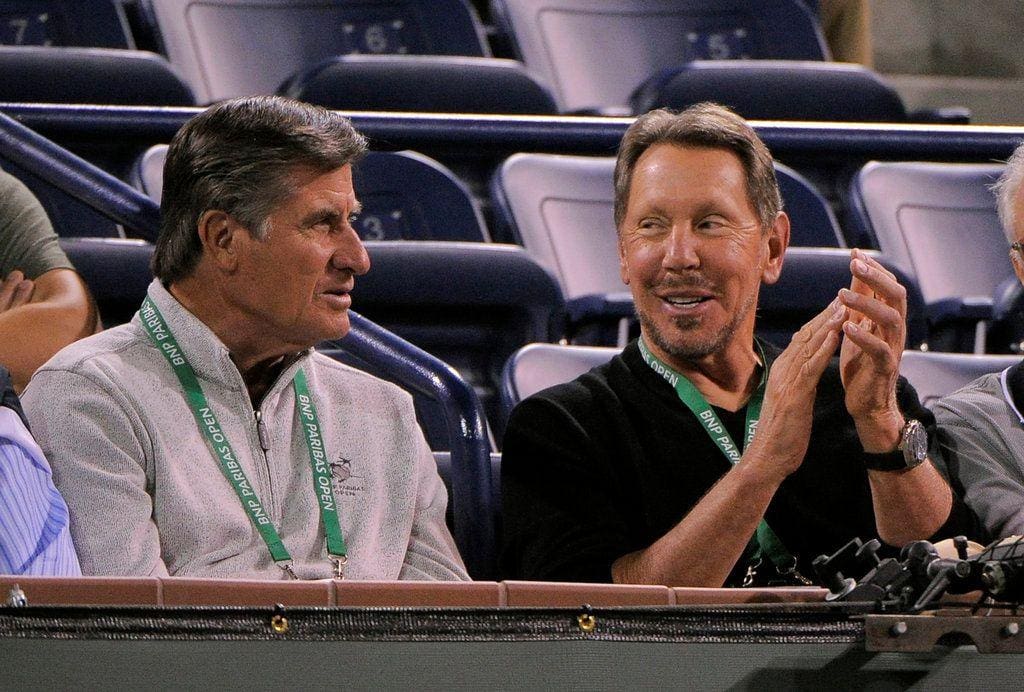
Larry Ellison turned Indian Wells into the gold standard of non-Grand Slam tennis after rescuing the BNP Paribas Open in 2009. Yet as a privately controlled asset with no publicly disclosed succession framework, its long-term future remains structurally opaque.
The Day Indian Wells Almost Became a Middle Eastern Export
In late 2008, with the global financial system in freefall and IMG desperate to offload assets, the BNP Paribas Open, the crown jewel of non-Grand Slam tennis, nestled in the Coachella Valley desert, was quietly being packaged for sale to buyers in Doha and Shanghai. The tournament that had spent three decades becoming one of professional tennis’s most beloved events, that had built a purpose-built 54-acre campus in the California desert and lured the world’s best players to a city of 5,000 people in the middle of nowhere, was weeks away from becoming a foreign-owned property that would almost certainly have been relocated out of America entirely.
Tournament director Tommy Haas said it plainly: “Once the crash happened in ’08, this tournament was struggling a little bit and there were rumors going around that it was going to be bought and it might move to China.”
Then Larry Ellison made a phone call.
The Oracle co-founder, already one of the wealthiest individuals on earth, purchased 100% of the Indian Wells Tennis Garden and the BNP Paribas Open through his private entity Tennis Ventures LLC in December 2009 for a reported $100 million, buying out co-founders Charlie Pasarell and Raymond Moore alongside investor-shareholders that included Pete Sampras, Chris Evert, and Billie Jean King. It was the kind of transaction that looks, in retrospect, like the most consequential single decision in the history of non-Grand Slam tennis.
What no one fully understood at the time was just how far Ellison intended to go.
A Five-Year Plan. Completed in Twelve Months.
The $100 million was the opening bid. What followed was something closer to an obsession. Ellison subsequently invested an additional $200 to $230 million in capital improvements to the Indian Wells Tennis Garden, a figure that, when added to the acquisition price, puts his total outlay north of $300 million on a tournament that runs for two weeks a year in the California desert. That number alone would be remarkable. What makes it extraordinary is the pace at which he deployed it.
When architects presented Ellison with a five-year construction plan for the venue’s expansion following the 2013 tournament, he agreed to fund it on one condition: it had to be finished in twelve months. It was. The result was a permanent second stadium with 8,000 seats and three fine-dining restaurants, including a Nobu, rising from what had previously been temporary infrastructure, the kind of facility that other Masters 1000 tournaments spend decades trying to approve through committee.
Ahead of the 2017 tournament, Ellison authorised a wholesale renovation of the 16,100-seat Stadium 1, the world’s second-largest outdoor tennis stadium after Arthur Ashe Stadium at the US Open, gutting and replacing the seating, lowering the court surface to accommodate recessed broadcast cameras, adding a VIP Champions Club, remodelling the suites, and installing 21 new restaurants and concession areas. In 2013, Indian Wells became the first tournament anywhere in the world to deploy Hawk-Eye electronic line-calling across all nine match courts, not just the show courts, and installed site-wide public wi-fi capable of supporting 25,000 simultaneous users — infrastructure that most airports at the time could not match.
The venue has won the ATP Tour and WTA Tour’s Tournament of the Year award for ten consecutive years.
But building the most impressive non-Grand Slam facility on earth and actually making money from it are two very different propositions.
The Business Case: $852 Million and a Secret Balance Sheet
Here is what we know. Tournament officials told NPR explicitly that the BNP Paribas Open has always turned a profit, a statement that has never been publicly contested, retracted, or qualified.
The 2024 tournament drew 493,440 attendees across two weeks in March, surpassing the French Open’s total attendance in the same window and setting a record that stood for exactly one year before the 2025 edition broke it again with 504,268. A third-party economic impact study commissioned for the 2024 event calculated that the tournament injected $852 million into the Coachella Valley regional economy, with 94% of attendees travelling from outside the local area.
Prize money reached $19 million in 2024, a record that prompted rival tournament owners to complain, loudly, that Ellison was distorting the economics of the entire tour. Tournament CEO Raymond Moore, responding to those complaints in a 2013 Marketplace interview, offered an assessment that has aged rather well: “He didn’t get to be the fifth-richest man in the world by just throwing money out the window. These are calculated business decisions.”
Here is what we do not know. Because Tennis Ventures LLC is a private entity, no audited financial statements are available to outside analysts, journalists, or competitors. The precise return on a $300-million-plus investment in a two-week annual event remains unknown, and will likely remain so for as long as Ellison chooses not to disclose it.
What every public indicator suggests, though, is that Ellison is not losing money and that profitability, in any case, was never really the point.
What $300 Million Actually Buys You: Power
The financial returns are interesting. The power is more so.
When Ellison bought the BNP Paribas Open, he acquired something that no federation official, no ATP board member, and no Grand Slam committee has ever possessed in quite the same form: the unilateral authority to make whatever decision he chooses about one of professional tennis’s most important events, answerable to no one except the ATP and WTA’s baseline regulatory requirements, and constrained by nothing except his own judgment and ambition. He sets the prize money. He controls the surface, the sightlines, the broadcast infrastructure, the catering contracts, and the fan experience in their entirety.
When he decided to become the first tournament in the world to install Hawk-Eye on every court, he made that call the same day he thought of it. When Miami Open founder Butch Buchholz watched what Ellison was building, he said: “Indian Wells has made everyone push to improve the venue and the fan experience.” That is one of the most remarkable admissions in modern sports business, a competitor acknowledging that one man’s private vision had reset the standard for an entire global circuit.
And then there was Serena.
In 2001, during a match at Indian Wells involving Venus Williams, the crowd booed Serena Williams so viciously, in a moment widely understood to be racially motivated, that she vowed never to return. For fourteen years, she kept that promise, her absence casting a shadow over the tournament that no amount of prize money or construction could lift.
The WTA and ATP, the two governing bodies whose collective authority over professional tennis is supposedly absolute, could not fix it. When WTA CEO Stacey Allaster and tournament CEO Raymond Moore began the delicate process of trying to broker a reconciliation in 2014, Williams made her position clear: she would need to hear from the owner himself. Ellison called. She announced her return in a February 2015 column for Time magazine. A single billionaire resolved in one phone call what the sport’s own institutions had failed to resolve in fourteen years.
That is what unilateral ownership looks like when it works and it raises an uncomfortable question about what it looks like when it doesn’t.
The Ticking Clock: One Man, No Blueprint
The BNP Paribas Open is, in every measurable sense, a triumph — of vision, of capital, of what happens when a single person with unlimited resources and genuine passion decides to build something great and refuses to wait for consensus. It is also, structurally, one of professional tennis’s most precarious institutions.
Larry Ellison was born in August 1944. He turned 80 in 2024. No succession plan for Tennis Ventures LLC has been publicly disclosed. There is no board to assume control, no institutional shareholder to enforce continuity, no federated body with automatic standing to intervene. The ATP and WTA’s rules govern which tournaments retain their Masters-level calendar slots and under what conditions those slots can be transferred, but the rules say nothing about how to replicate the specific combination of financial commitment, personal taste, and operational obsession that has made Indian Wells what it is.
Wimbledon is owned by the All England Club, a membership institution incorporated in 1868. The US Open is owned by the USTA, a national federation with its own board, bylaws, and succession structure. Both will exist in recognisable form long after every person currently running them is gone.
Indian Wells is governed by a man. The same absence of bureaucracy that allowed Ellison to renovate a stadium in twelve months and end a fourteen-year boycott with a single phone call is the reason that no one, not the ATP, not the WTA, not the city of Indian Wells, can tell you with any confidence what this tournament looks like in ten years.
If Tennis Ventures LLC is sold, it is not clear whether the Masters 1000 licence travels automatically with the asset or whether the ATP retains the right to reassign it.
If a sovereign wealth fund, the kind of institutional buyer now circling every premium sports property from golf to Formula 1, were to acquire the tournament, the ATP would face a question it has never been required to answer: does a state-backed entity from the Gulf or Asia qualify as an appropriate steward of one of tennis’s most important calendar slots, and if not, what leverage does the tour actually have to say no?
These are not hypothetical concerns. They are the leverage map that tennis has chosen, so far, not to draw.
Indian Wells is the greatest non-Grand Slam tournament on earth, and its entire future rests inside the mind of one 80-year-old billionaire who has never said publicly what happens next.
Capital Rally View
The story of Larry Ellison and Indian Wells is not, at its core, a story about tennis.
It is a story about what private capital can achieve when it is wielded with conviction and insulated from the timidity of institutional decision-making and about the price that achievement extracts in return, paid not now but later, and paid not by Ellison but by the sport.
He rescued a tournament that was days from leaving America, rebuilt it into something that makes the French Open look underpopulated, and did all of it faster and better than any committee, federation, or publicly accountable body could have managed. The paradox is that every quality that made this possible, the unilateral authority, the personal vision, the absence of governance, is precisely what makes the tournament’s future unknowable.
Indian Wells is Ellison’s masterpiece. It is also his hostage.
The Bottom Line
More than half a million people will pass through Indian Wells this March, in a desert city of 5,000 people, to watch tennis at a venue that did not exist in its current form fifteen years ago, at a tournament that was nearly sold to buyers in Doha and Shanghai and turned into something else entirely. They will sit in seats that one man paid for, on courts that one man built, at a prize money level that one man set, inside an institution that has no publicly documented plan for the morning after that one man is gone.
Professional tennis has never produced anything quite like the BNP Paribas Open under Larry Ellison — and that is precisely the problem.
Sources
1. NPR / Marketplace, March 2013
2. Indian Wells Tennis Garden, Official History
3. BNP Paribas Open, Official Tournament History
4. Wikipedia, Indian Wells Open
5. Men’s Journal, December 2013
6. ESPN, March 2015
7. Tennis.com, February 2015
8. Tennis.com, “One of a Kind: The Indian Wells Experience”
9. Front Office Sports
10. Palm Springs Life, October 2024
11. BNP Paribas Open, December 2024
12. ESPN, March 2025
13. Yahoo Sports
14. University of Oregon Warsaw Sports Marketing Center